Commuter Behaviour, Mode Choice, and Service Quality Assessment
ON GOING
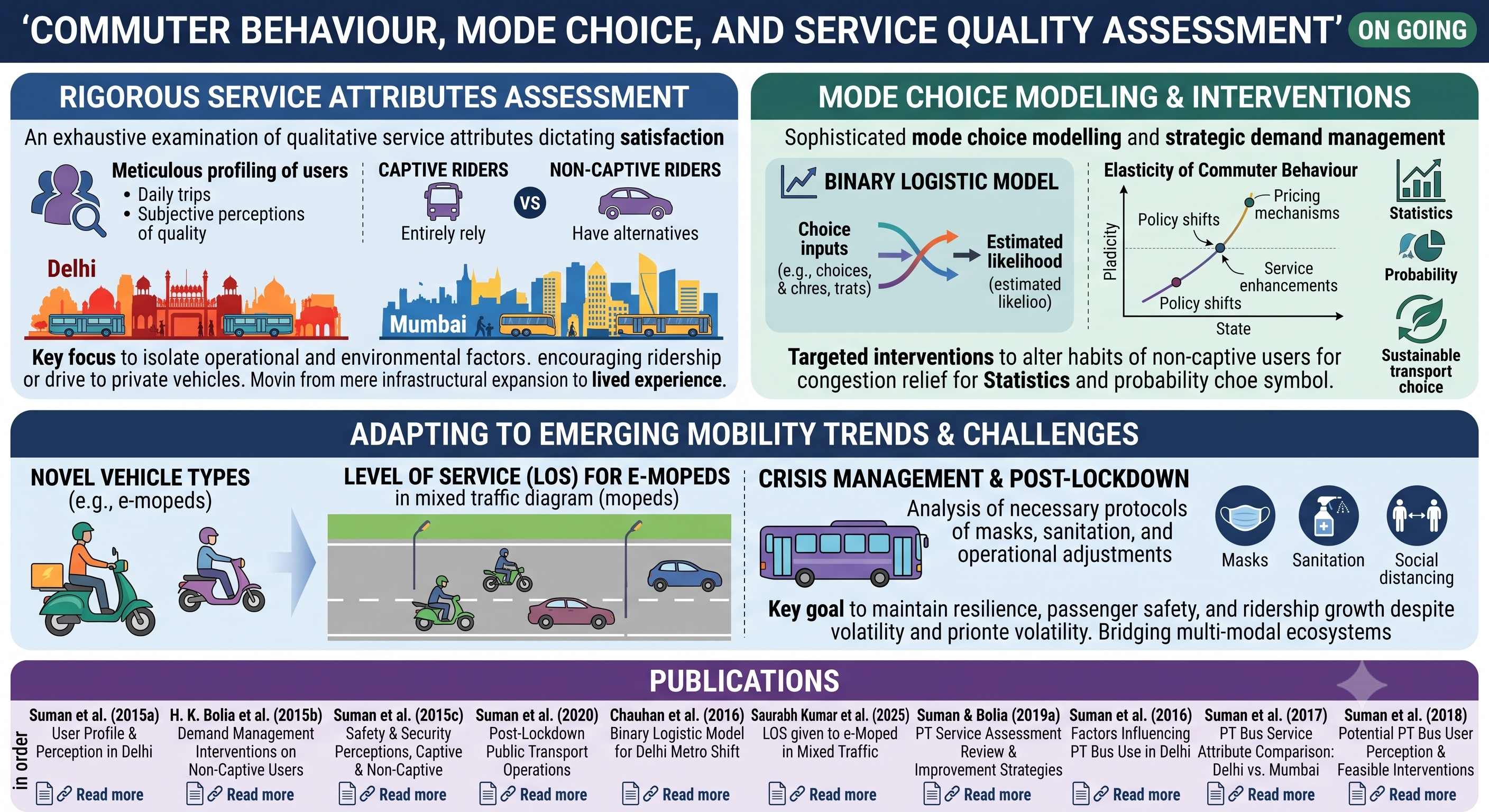
This research investigates the qualitative and quantitative factors influencing commuter mode choice and their perception of public transport. By analysing safety, security, and demand management interventions, these studies assess service attributes to help policymakers understand commuter behaviour and encourage mode shifts towards sustainable transit systems.
This research group conducts an exhaustive examination of the qualitative service attributes that dictate commuter satisfaction and the subsequent propensity to utilise public transport. The extensive studies involve meticulous profiling of bus users, capturing the intricate details of their daily trips, and assessing their subjective perceptions of service quality. A critical dimension of this work is the rigorous evaluation of safety and security perceptions among both captive riders, who rely entirely on public transit, and non-captive riders, who possess alternative modes of transport. By systematically comparing transport service attributes across major urban centres like Delhi and Mumbai, the researchers isolate the specific operational and environmental factors that either encourage ridership or drive commuters towards private vehicles. This granular understanding of user profiles allows for a highly targeted approach to service improvement, shifting the focus from mere infrastructural expansion to the actual lived experience of the urban commuter.
Building upon the foundational profiling of commuters, a substantial segment of this literature focuses on sophisticated mode choice modelling and the strategic implementation of demand management interventions. The research incorporates predictive frameworks, such as binary logistic models, to estimate the likelihood of a mode shift from private vehicles or standard buses into higher-capacity systems like the Delhi Metro. The authors explore the elasticity of commuter behaviour when presented with policy shifts, pricing mechanisms, or service enhancements. The studies critically analyse how targeted interventions can successfully alter the commuting habits of non-captive users, which is essential for alleviating urban traffic congestion. By quantifying the variables that trigger a behavioural shift, this research provides policymakers with actionable, data-driven insights. Consequently, transport authorities can design and deploy demand management strategies that are not only theoretically sound but have a proven, statistically validated probability of encouraging sustainable transport choices among the broader public.
The scope of this behavioural research continually adapts to encompass emerging mobility trends and unprecedented operational challenges. Recent publications reflect this adaptability by addressing the integration of novel vehicle types and crisis management. The researchers have developed systems for assessing the Level of Service afforded to e-mopeds navigating mixed traffic environments, acknowledging the rapid diversification of urban micro-mobility. Furthermore, the laboratory has swiftly responded to global disruptions, analysing the necessary protocols and operational adjustments required to sustain public transport operations effectively in post-lockdown scenarios. This forward-looking perspective ensures that the assessment frameworks remain relevant in a dynamic transportation landscape. By bridging the gap between traditional bus service metrics and the realities of modern, multi-modal urban ecosystems, the research equips transit agencies with the comprehensive strategies necessary to maintain resilience, ensure passenger safety, and foster continuous growth in ridership despite external volatilities.
Publications
User Profile, Trip Profile, and Perception of Bus Commuters in Delhi, India
Suman, H. K., Bolia, N. B., & Tiwari, G. (2015a, January 15). User Profile, Trip Profile, and Perception of Bus Commuters in Delhi, India (Nos. 15–0538). Article 15–0538. Transportation Research Board 94th Annual Meeting Transportation Research Board.
Impact of Demand Management Interventions on Behaviour of Non-Captive Bus Users
H. K., Bolia, N. B., & Tiwari, G. (2015b, August 3). Impact of Demand Management Interventions on Behaviour of Non-Captive Bus Users. Proceedings of the Tenth Annual International Conference on Public Policy and Management,. Tenth Annual International Conference on Public Policy and Management
Safety and Security Perceptions Amongst Captive and Non-captive Users of Public Bus Transport
Suman, H. K., Bolia, N. B., & Tiwari, G. (2015c, December 3). Safety and Security Perceptions Amongst Captive and Non-captive Users of Public Bus Transport. 25th International Symposium on Transport Planning and Traffic Safety.
Public Transport Operations After Lockdown: How to Make It Happen?
Suman, H. K., Agarwal, A., & Bolia, N. B. (2020). Public Transport Operations After Lockdown: How to Make It Happen? Transactions of the Indian National Academy of Engineering, 5(2), 149–156. https://doi.org/10.1007/s41403-020-00121-x
Binary Logistic Model for Estimation of Mode Shift into Delhi Metro
Chauhan, V., Suman, H. K., & Bolia, N. B. (2016). Binary Logistic Model for Estimation of Mode Shift into Delhi Metro. The Open Transportation Journal, 10(1), 124–136. https://doi.org/10.2174/1874447801610010124
A System for Assessing the LOS Given to e-Moped in Mixed Traffic Based on Frequency Adoption
Saurabh Kumar, S., Suman, H. K., Chalumuri, R. S., & Gurjar, B. R. (2025). A System for Assessing the LOS Given to e-Moped in Mixed Traffic Based on Frequency Adoption. In P. K. Sahu, S. Das, M. Manoj, & A. Budhkar (Eds.), Proceedings of the 7th International Conference of Transportation Research Group of India (CTRG 2023), Volume 2 (Vol. 426, pp. 137–150). Springer Nature Singapore. https://doi.org/10.1007/978-981-96-1037-2_9
A Review of Service Assessment Attributes and Improvement Strategies for Public Transport
Suman, H. K., & Bolia, N. B. (2019a). A Review of Service Assessment Attributes and Improvement Strategies for Public Transport. Transportation in Developing Economies, 5(1), 1. https://doi.org/10.1007/s40890-018-0069-x
Analysis of the Factors Influencing the Use of Public Buses in Delhi. Journal of Urban Planning and Development
Suman, H. K., Bolia, N. B., & Tiwari, G. (2016). Analysis of the Factors Influencing the Use of Public Buses in Delhi. Journal of Urban Planning and Development, 142(3), 04016003. https://doi.org/10.1061/(ASCE)UP.1943-5444.0000316
Comparing public bus transport service attributes in Delhi and Mumbai: Policy implications for improving bus services in Delhi
Suman, H. K., Bolia, N. B., & Tiwari, G. (2017). Comparing public bus transport service attributes in Delhi and Mumbai: Policy implications for improving bus services in Delhi. Transport Policy, 56, 63–74. https://doi.org/10.1016/j.tranpol.2017.03.002
Perception of potential bus users and impact of feasible interventions to improve quality of bus services in Delhi
Suman, H. K., Bolia, N. B., & Tiwari, G. (2018). Perception of potential bus users and impact of feasible interventions to improve quality of bus services in Delhi. Case Studies on Transport Policy, 6(4), 591–602. https://doi.org/10.1016/j.cstp.2018.07.009
People Working