Transit Network Optimisation and Operational
ON GOING
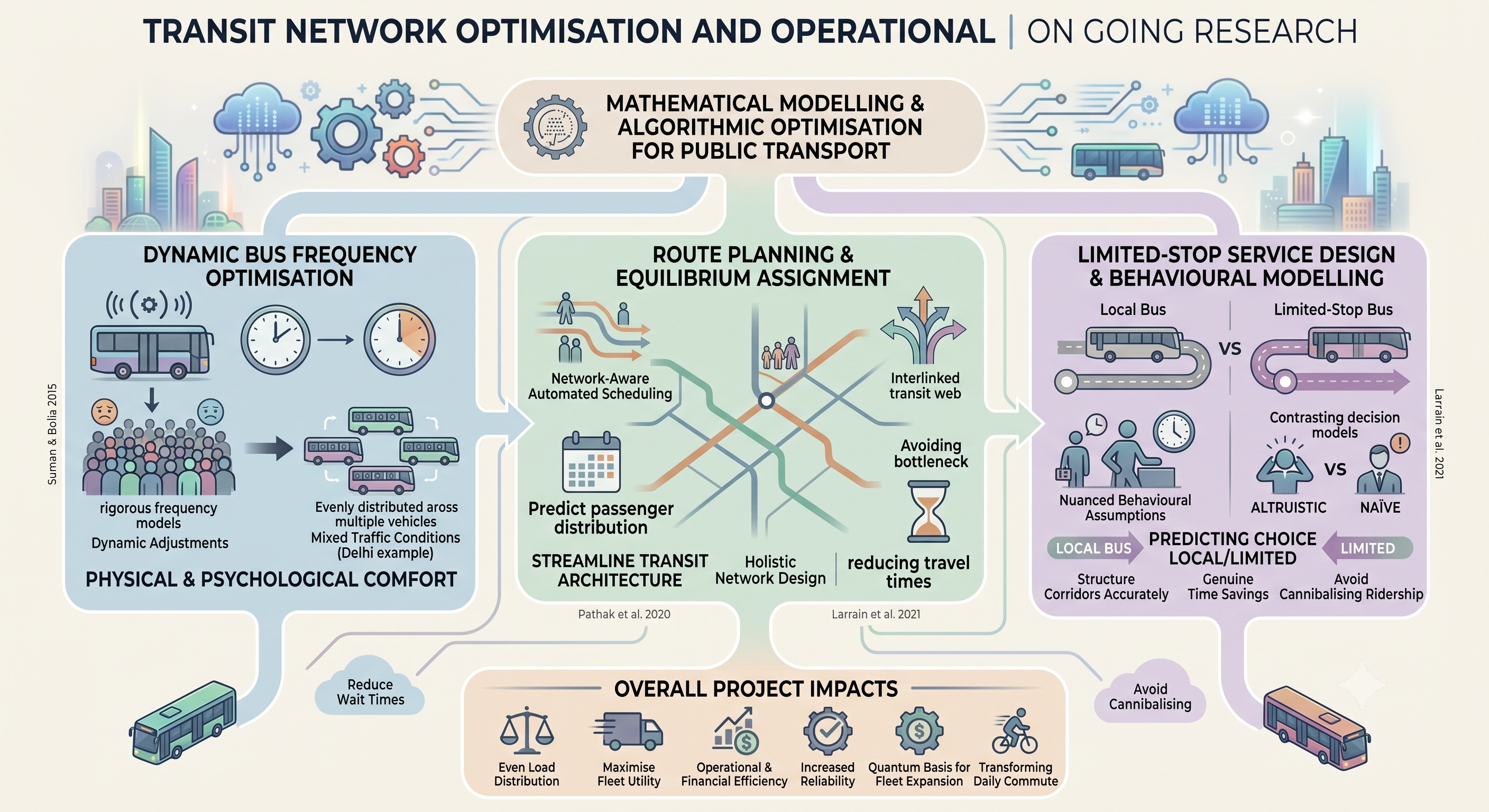
This research focuses on the mathematical modelling and algorithmic optimisation of public transport networks. By developing network-aware scheduling and equilibrium assignment models, the work aims to mitigate bus overcrowding, improve limited-stop service designs, and enhance both operational efficiency and commuter comfort in highly congested urban environments.
The core of this research theme involves addressing the chronic issue of overcrowding in urban bus systems through rigorous frequency optimisation models. The studies explicitly tackle the physical and psychological discomfort experienced by commuters in densely packed transit vehicles. By developing mathematical frameworks that adjust bus frequencies dynamically under mixed traffic conditions, the researchers aim to distribute passenger loads more evenly across the network. These optimisation techniques move beyond simple capacity calculations; they incorporate the tangible impacts of crowding on passenger satisfaction and route viability. The implementation of such models ensures that transit authorities can maximise the utility of their existing fleets, thereby reducing wait times and alleviating the severe congestion that often deters potential riders from relying on public transport in sprawling metropolises like Delhi. Furthermore, the models provide a quantitative basis for transit agencies to justify budget allocations for fleet expansion on specific high-demand routes, ultimately transforming the daily commuting experience from one of distress to one of reliability.
Expanding beyond frequency adjustments, a significant portion of this work delves into complex route planning and equilibrium assignment within congested networks. The research explores how network-aware automated scheduling systems can revolutionise operational efficiency and financial performance. By treating the transit system as an interconnected web rather than isolated routes, these studies analyse how alterations in one corridor ripple through the entire network. The route-based equilibrium assignment models are particularly crucial, as they predict how passengers will logically distribute themselves across available services when facing varying levels of congestion and wait times. Consequently, these sophisticated planning tools enable transit operators to design direct bus services that bypass unnecessary bottlenecks, streamlining the overarching transit architecture and significantly reducing end-to-end travel times for the majority of urban commuters. This holistic approach to network design is essential for modernising legacy transit systems, ensuring they remain resilient and adaptable to the ever-changing demands of a rapidly growing urban population.
A highly specialised focus within this optimisation group is the intricate design and evaluation of limited-stop bus services. The collaborative publications address the nuanced behavioural assumptions that underpin transit modelling, specifically contrasting the impacts of assuming altruistic behaviour versus employing a naïve approach in service design problems. The researchers demonstrate that predicting how passengers choose between local and limited-stop services requires a deep understanding of human decision-making under time constraints. When models inaccurately assume that passengers will strictly optimise the system's overall efficiency rather than their individual travel times, the resulting schedules can lead to suboptimal fleet deployment and unexpected crowding. By rigorously testing these behavioural parameters, the laboratory's output provides transit planners with robust, evidence-based methodologies to structure limited-stop corridors accurately. This ensures that rapid transit options function as intended, offering genuine time savings for long-distance commuters without inadvertently cannibalising the ridership or degrading the service quality of the foundational local bus network.
Publications
Bus Frequency Optimization under Mixed Traffic Condition for Delhi
Suman, H. K., & Bolia, N. B. (2015, July 12). Bus Frequency Optimization under Mixed Traffic Condition for Delhi. 27th European Conference on Operational Research.
Route based equilibrium assignment in congested transit networks
Larrain, H., Suman, H. K., & Muñoz, J. C. (2021). Route based equilibrium assignment in congested transit networks. Transportation Research Part C: Emerging Technologies, 127, 103125. https://doi.org/10.1016/j.trc.2021.103125
Design and implementation of a network-aware automated bus scheduling system for optimizing operational efficiency and financial performance
Borade, P., Nagar, G., Suman, H. K., Lakshay, L., Gadepalli, R., & Bolia, N. B. (2025). Design and implementation of a network-aware automated bus scheduling system for optimizing operational efficiency and financial performance. Case Studies on Transport Policy, 20, 101448. https://doi.org/10.1016/j.cstp.2025.101448
Frequency optimization-based approach for reducing crowding discomfort in Delhi bus system
Pathak, P., Agrawal, K., Suman, H. K., & Bolia, N. B. (2020). Frequency optimization-based approach for reducing crowding discomfort in Delhi bus system. Procedia Computer Science, 170, 265–272. https://doi.org/10.1016/j.procs.2020.03.039
Addressing Overcrowding of Buses in Delhi
Suman, H. K., & Bolia, N. B. (2016, September 6). Addressing Overcrowding of Buses in Delhi. OR58 Anual conference of the Operational Research Society, Portsmouth, UK.
Frequency Optimization Models for Reducing Overcrowding Discomfort
Agrawal, K., Suman, H. K., & Bolia, N. B. (2020). Frequency Optimization Models for Reducing Overcrowding Discomfort. Transportation Research Record: Journal of the Transportation Research Board, 2674(5), 160–171. https://doi.org/10.1177/0361198120912230
Improvement in direct bus services through route planning
Suman, H. K., & Bolia, N. B. (2019b). Improvement in direct bus services through route planning. Transport Policy, 81, 263–274. https://doi.org/10.1016/j.tranpol.2019.07.001
Mitigation of overcrowding in buses through bus planning
Suman, H. K., & Bolia, N. B. (2019c). Mitigation of overcrowding in buses through bus planning. Public Transport, 11(1), 159–187. https://doi.org/10.1007/s12469-019-00197-x
The impact of assuming altruistic behavior in the limited-stop bus service design problem
Suman, H., Larrain, H., & Muñoz, J. C. (2019). The impact of assuming altruistic behavior in the limited-stop bus service design problem. Chilean Congress of Transport Engineering
The impact of using a naïve approach in the limited-stop bus service design problem
Suman, H., Larrain, H., & Muñoz, J. C. (2021). The impact of using a naïve approach in the limited-stop bus service design problem. Transportation Research Part A: Policy and Practice, 149, 45–61. https://doi.org/10.1016/j.tra.2021.04.018
People Working